Library
Reading Your Competitors' Ads at Scale with the Meta Ads Library - slide 1
Reading Your Competitors' Ads at Scale with the Meta Ads Library - slide 2
Reading Your Competitors' Ads at Scale with the Meta Ads Library - slide 3
Reading Your Competitors' Ads at Scale with the Meta Ads Library - slide 4
Reading Your Competitors' Ads at Scale with the Meta Ads Library - slide 5
Reading Your Competitors' Ads at Scale with the Meta Ads Library - slide 6
Reading Your Competitors' Ads at Scale with the Meta Ads Library - slide 7
1/7
Meta Ads

Reading Your Competitors' Ads at Scale with the Meta Ads Library

The Meta Ads Library shows you every active ad your competitors run. This page breaks down how to pull that data properly and use AI to find the patterns worth stealing from.

Get the workflow and prompt ↓

The short version

  • Every active Facebook and Instagram ad is public in the Meta Ads Library.
  • Scraping beats scrolling because one screenshot is not research.
  • Sort by start date - long-running ads are usually the winners.
  • Feed a batch of ads into an LLM to surface the shared hooks and angles.
  • Use what you find as a starting brief, not a copy-paste template.

As promised in the reel

Get the workflow and prompt.

The exact thing, ready to use. Copy it, change the parts in [BRACKETS], go.

Workflow

Competitive ad intelligence workflow

In the reel: “Comment LIBRARY and I'll send you the full workflow”

Turns your competitors' live ads into a data-backed creative brief.

The Meta Ads Library is public and holds every active ad on Facebook and Instagram. Pull them at scale, sort by what has survived longest, and let an LLM surface the patterns.

  1. 1List the competitors you want to study by their Facebook Page names.
  2. 2Open the Meta Ads Library and confirm each competitor has active ads showing.
  3. 3Use a scraper or the Meta Ads Library API to pull all active ads for each competitor, capturing the copy, the creative, the start date and every variation they are testing.
  4. 4Sort every pulled ad by its start date, oldest first. An ad running for four months is not an accident, since nobody keeps a losing ad live.
  5. 5Keep the longest-running ads at the top as your highest-signal set.
  6. 6Export or copy roughly 200 of these ads into a single document.
  7. 7Paste the ads into Claude or GPT and run the pattern-analysis prompt to find what the hooks, angles and offers have in common.
  8. 8Treat the output as your creative brief.
  9. 9Do not copy the ads directly. You only see the creative, not their numbers, so push the winning patterns sharper for your own offer.

How to use it: Work through the steps in order. Use the pattern-analysis prompt in the next resource for the LLM step.

Rebuilt from what the reel shows. Swap in your own details.
Prompt

Ad pattern-analysis prompt

In the reel: “Dump 200 ads into Claude or GPT. Ask what the hooks, angles and offers have in common.”

Extracts the repeating hooks, angles and offers from a batch of competitor ads so you have a creative brief.

You are a direct-response ad strategist. Below is a set of [NUMBER] active ads scraped from the Meta Ads Library, run by competitors in the [YOUR INDUSTRY/NICHE] space. For each ad I have included the copy, a description of the creative, and the start date. The ads that have been running longest are the ones I most want you to weight, because nobody keeps a losing ad live.

Analyse the full set and tell me:
1. HOOKS: What opening lines, first frames or attention-grabbing devices repeat across the ads? Group them into recurring hook types.
2. ANGLES: What core messages, promises and pain points come up again and again? Which angles appear in the longest-running ads?
3. OFFERS: What offers, formats, guarantees and calls to action are most common? Note any that persist across months.
4. PATTERNS BY LONGEVITY: Separate the patterns found in ads running the longest from those in newer or short-lived ads, so I can see what has likely been validated.
5. BRIEF: Based on the above, write a short creative brief for my own ads that starts from what the market already rewards and pushes it sharper. Do not tell me to copy any single ad.

Here are the ads:
[PASTE YOUR SCRAPED ADS HERE, ONE PER BLOCK, WITH COPY, CREATIVE DESCRIPTION AND START DATE]

How to use it: Paste into Claude or GPT, then add your scraped ads where shown. Prioritise the longest-running ads first.

Rebuilt from what the reel shows. Swap in your own details.

Going deeper

The research is already sitting in public

Your competitors publish their playbook every time they launch a campaign. The Meta Ads Library holds every active ad across Facebook and Instagram, and anyone can open it.

Most people treat it like a scrapbook. They search a brand, screenshot one ad that catches their eye, and call it research.

That is not research. That is a single data point with no context around it.

Use the API instead of your thumb

Scrolling is the bottleneck. You can only hold a handful of ads in your head before they blur together.

A scraper pulls hundreds of ads in seconds. The copy, the creative, the start date, and every variation a brand is currently testing all land in one place where you can actually sort them.

I keep seeing people underestimate the variation part. Seeing that a brand is running twelve versions of the same hook tells you more than any single ad ever could.

Start date is the tell

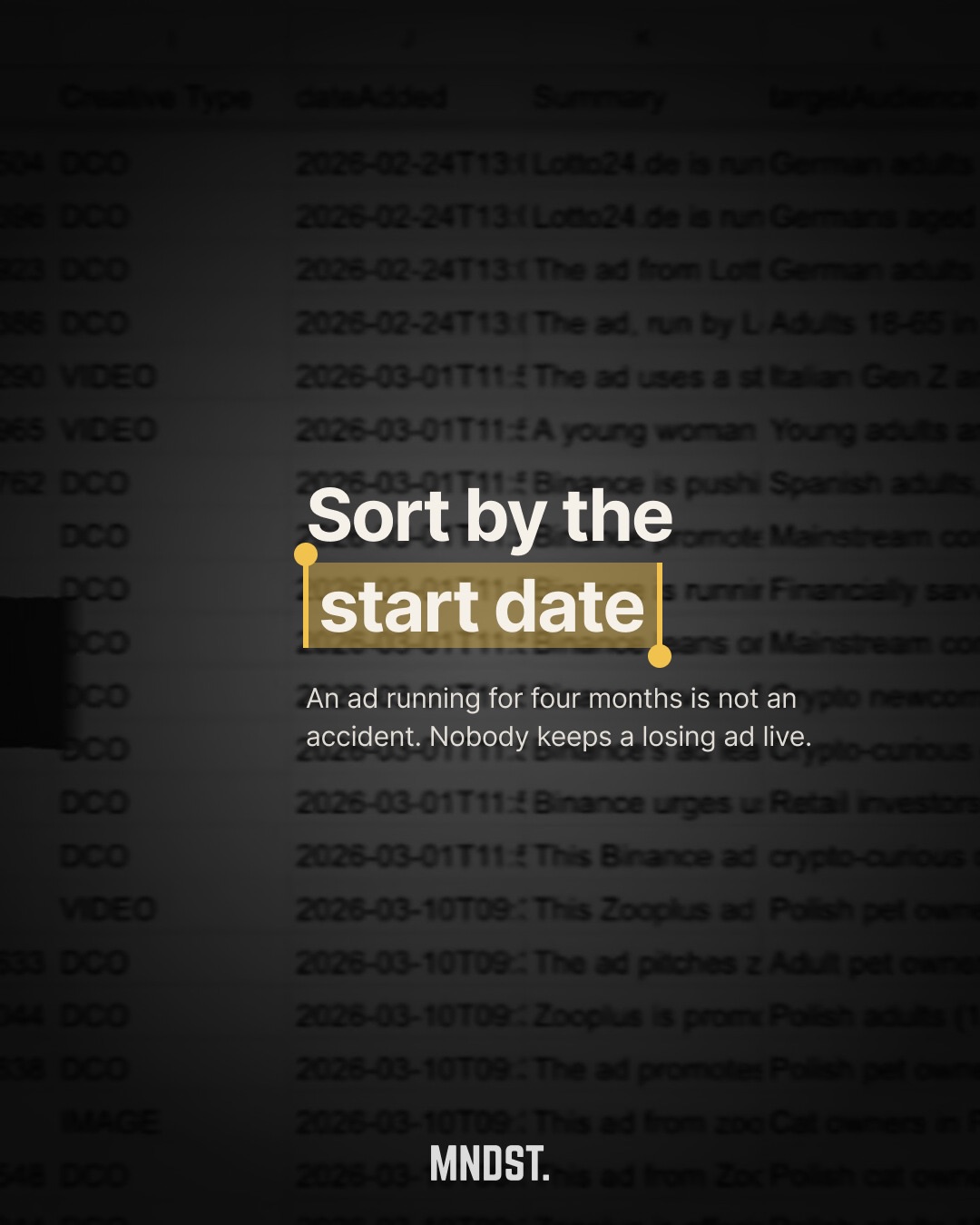
An ad that has been live for four months is not an accident. Ad accounts are ruthless. Nobody pays to keep a losing ad running.

So sort your scraped data by start date and let longevity do the filtering for you. The ads that survived are the ones the market kept rewarding.

My read is this is the single most useful column in the whole export. Everything else is noise until you know what has staying power.

Let the model do the pattern work

Reading 200 ads by hand is where the project usually dies. This is the part to hand off.

Drop the batch into Claude or GPT and ask a plain question: what do these hooks, angles, and offers have in common? The model is good at naming the shape of things you half-noticed but could not articulate.

What comes back is a brief. Not a finished idea, but the raw shape of what is working in your category right now.

Inform, don't imitate

You can see the creative. You cannot see the spend, the conversion rate, or the margin behind it. That gap matters.

So copying an ad outright is a gamble dressed up as a shortcut. You are inheriting their guesses without their numbers.

Start from what the market already rewards, then push it sharper. Take the proven angle and make it more specific to your offer, your voice, your audience. Informed inference beats a coin flip, and that is the whole point of doing the work properly.

Want to go deeper?

Let's look at it together.

One call, one on one. We take this and apply it to your account or your workflow.

Book a call

Further reading