Library
AI Tools

Building Functional UI With Claude Instead of Coding It

Claude can turn plain English into working HTML and functional interfaces in seconds. This page breaks down how founders use it to prototype MVPs without building every screen from scratch.

The short version

  • Claude Design turns plain-English prompts into working HTML, CSS, and React
  • Write your prompt in Claude first, then feed it into Claude Design for cleaner results
  • Prototyping that used to take hours now takes minutes
  • The bottleneck for founders is no longer the code, it is the clarity of the idea
  • Structured prompts beat vague ones every single time

Going deeper

The old way of prototyping was slow for no good reason

Most founders lose weeks turning an idea into something clickable. You sketch it, hand it off, wait for a developer, then wait again for changes.

Claude collapses that loop. You describe the interface in plain language and it returns functional HTML you can actually open in a browser.

I keep seeing people treat this as a toy. It is not. It is a faster path from thought to screen, and speed is the whole point of an MVP.

How the two-step prompt actually works

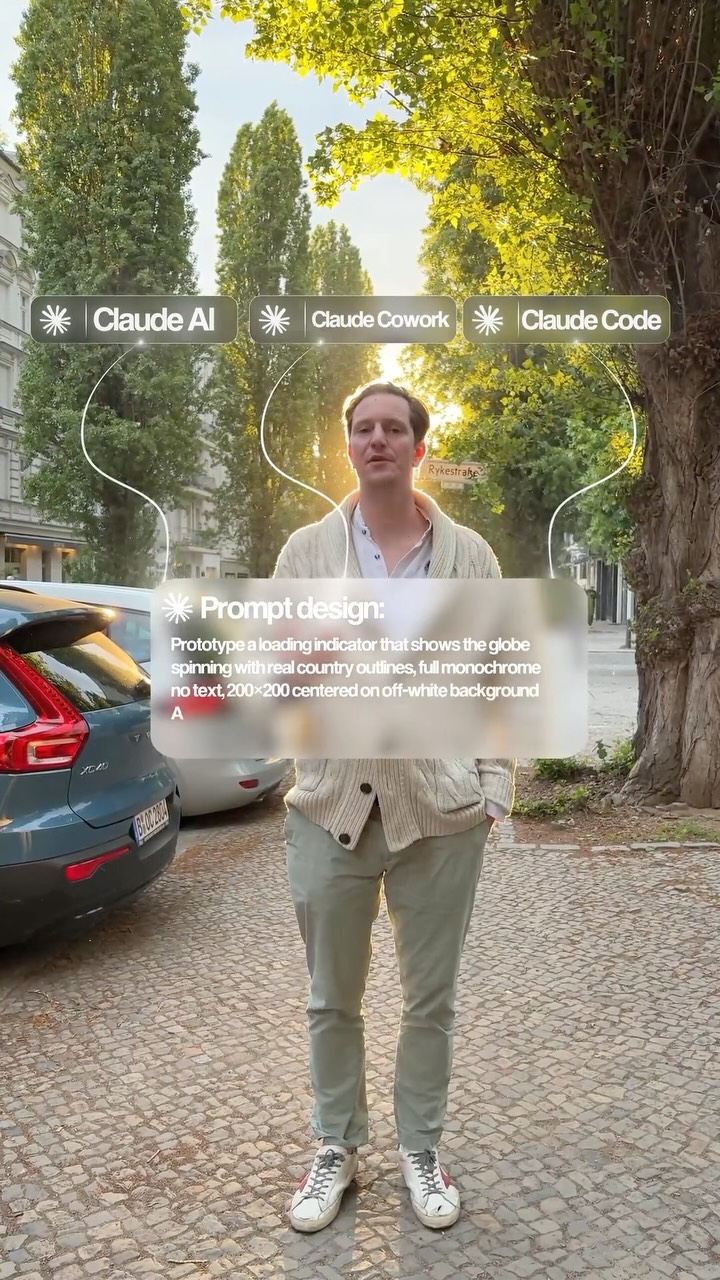
The trick I use is not to prompt Claude Design directly with a rough idea. I use Claude AI first to build a proper prompt, then paste that into Claude Design.

Think of the first step as writing the spec and the second as building from it. When the instruction is clear, the output is clean.

Claude Design is Anthropic's tool that turns plain-English prompts into working HTML, CSS, and React [4]. Feed it a vague request and you get a vague screen. Feed it structure and you get something close to shippable.

A real example of what this replaces

Someone built a full journaling app UI using only Claude, no Figma, and almost no code [1]. Daily prompts, mood tracking, saved entries, gentle insights, all described in words and generated as an interface.

That used to be a designer plus a front-end developer plus a week of back and forth.

My read is that founders should stop thinking of design as a separate hiring problem for the first version. Describe the thing, generate the thing, react to the thing.

Where it still needs a human

Generated UI is a starting point, not a finished product. Claude gives you something to react to, and reacting is easier than starting from a blank file.

Good designers have started running Claude prompts to audit their own work, checking for UX friction, accessibility issues, and drift from the original intent [2]. That tells you something. The output needs review, not blind trust.

The caveat is simple. This makes you fast, not correct. You still have to know what a good interface feels like.

Why this matters more for founders than designers

A founder does not need a perfect interface. They need proof the idea works enough to show someone.

Claude gets you to that proof in minutes instead of hours. You can test three versions of a flow before lunch and throw away the two that feel wrong.

The bottleneck was never really the code. It was the gap between having an idea and seeing it. Close that gap and you build differently.

Want to go deeper?

Let's look at it together.

One call, one on one. We take this and apply it to your account or your workflow.

Book a call

Sources